




“Enabling dishonest behaviour” is one of the most common reasons why affiliate marketers face account bans in Google Ads. This label applies to a wide range of activities, from promoting obvious scams like phishing websites to promoting other minor services like boosting Instagram followers. For affiliates operating in grayhat verticals, receiving a notification mentioning that they have triggered this violation feels like a constant threat, because an account ban can strike at any moment.
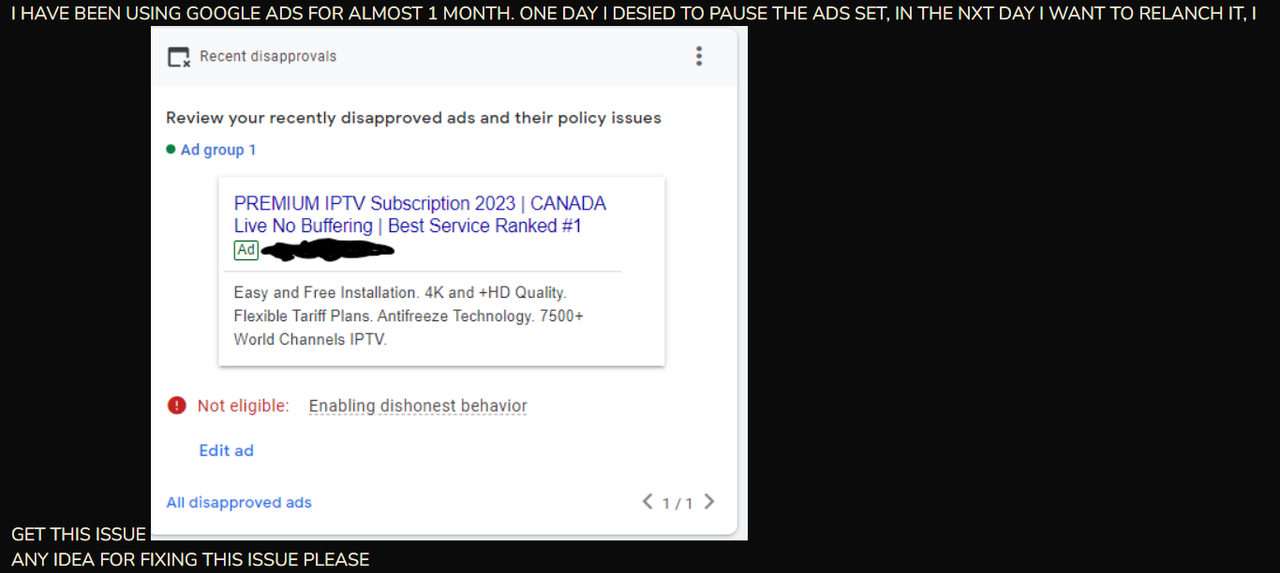
Sometimes, even campaigns promoting harmless offers, like paid subscriptions to legitimate services, can trigger this ban.
In this article, the YeezyPay team, a service that provides access to trusted Google Ads agency accounts, will explain in clear, detailed terms what Google considers “enabling dishonest behavior,” why these bans occur, how to protect your account from being banned, and whether it’s worth trying to restore a banned account.

A detailed explanation of each point can be obtained in a Google Gemini chat.
This broad interpretation means that only campaigns promoting fully compliant (whitehat) offers through Google-verified advertiser accounts are truly safe from bans. In the meantime, it should be understood that it is almost impossible to appeal a ban for enabling dishonest behavior. Violating this rule is considered critical and, in the vast majority of cases, it leads to a permanent ban of both the main account and all those associated with it.
The first recommendation you can get on all affiliate forums on how to avoid this ban is to use cloaking tools.

An example of this recommendation in one of the threads about the problem
There is nothing surprising about this: it is almost impossible to work with Google Ads without a cloaking software. You need to split the advertising campaign into two different streams and show Google algorithms that the offer is whitehat and does not contain unacceptable keywords, misleading content, clickbait ads, or any illegal or prohibited activities as stated by the Google policy. Cloaking can be done with software such as:
Some experienced affiliates on the Black Hat World (BHW) forum emphasize that carefully managing campaign settings during the initial warm-up phase is critical to avoiding bans.

In one of the threads, experienced affiliates recommend avoiding cloaking altogether and following a strict warm-up process to build trust with Google.
In short, the affiliates recommend:

These accounts offer several key advantages that significantly reduce the risk of facing bans for “enabling dishonest behavior”, and below are the reasons why:

Another forum user suggested filing appeals repeatedly, claiming that persistence would eventually lead to account restoration.

In reality, this approach is largely ineffective. After the fifth or sixth appeal, Google shifts to manual reviews, then all subsequent appeals with an attempt to prove that no one violated the rules are automatically rejected, regardless of their content or arguments.

Therefore, instead of wasting time on endless appeals after getting banned, it’s often more efficient to either switch to a new account or rent a trusted Google Ads agency account through YeezyPay. This allows you to bypass the frustration of dealing with a banned account and resume campaigns quickly, minimizing disruptions to your operations.
Sometimes, even campaigns promoting harmless offers, like paid subscriptions to legitimate services, can trigger this ban.
In this article, the YeezyPay team, a service that provides access to trusted Google Ads agency accounts, will explain in clear, detailed terms what Google considers “enabling dishonest behavior,” why these bans occur, how to protect your account from being banned, and whether it’s worth trying to restore a banned account.
What Is “Enabling Dishonest Behavior” According to Google?
Google’s official Advertising Policies include a specific category of offers (products and services) that violate the “enabling dishonest behavior” policy. According to Google, promoting content, products, or services designed to deceive users or facilitate unauthorized access to systems, devices, or property is labeled as “enabling dishonest behavior”. Google’s official Advertising Policies include a specific category of offers/ products and services that violate this policy. Typically, these include:- Services that sell fake documents, such as passports or diplomas.
- Services that sell numbers (e.g., “credit privacy numbers”) that mimic national identification numbers.
- Services that broker the inclusion of clients as authorized users on credit lines.
- Products that help to pass drug tests.
- Paper-writing or exam-taking services.
- Services that sell fake databases and user activity, such as invalid clicks, reviews, or social media endorsements.
- Spyware or surveillance technology marketed for tracking or monitoring someone without their consent, including malware that monitors texts, phone calls, or browsing history, GPS trackers for spying, or cameras and audio recorders promoted for spying purposes. (This does not include private investigation services or products designed for parents to monitor underage children.)
A detailed explanation of each point can be obtained in a Google Gemini chat.
This broad interpretation means that only campaigns promoting fully compliant (whitehat) offers through Google-verified advertiser accounts are truly safe from bans. In the meantime, it should be understood that it is almost impossible to appeal a ban for enabling dishonest behavior. Violating this rule is considered critical and, in the vast majority of cases, it leads to a permanent ban of both the main account and all those associated with it.
How to Protect Your Account from Being Banned for “Enabling dishonest behaviour”
To avoid being banned for enabling dishonest behaviour in Google Ads, you can use several methods: cloaking, optimizing your advertising campaigns, and using Google Ads trusted agency accounts. In the following section, we will tell you more about each method.The first recommendation you can get on all affiliate forums on how to avoid this ban is to use cloaking tools.
An example of this recommendation in one of the threads about the problem
There is nothing surprising about this: it is almost impossible to work with Google Ads without a cloaking software. You need to split the advertising campaign into two different streams and show Google algorithms that the offer is whitehat and does not contain unacceptable keywords, misleading content, clickbait ads, or any illegal or prohibited activities as stated by the Google policy. Cloaking can be done with software such as:
- Zeustrack
- Adspect
- Cloakerly
- LeadCloack
- Cloaking won't help if the account doesn't have a high trust level: Sometimes, whitehat campaigns can be banned for enabling dishonest behavior if the account is new or hasn’t been properly warmed up. And sometimes, getting banned for enabling dishonest behavior is justified as “banning for multi-accounts”, especially if Google was able to link a previously banned account to a new one. Trusted agency accounts from YeezyPay solve this problem.
- Quality software is expensive: On average, you will have to pay from $150 to $350 per month. In some cases, for example, for large media buying teams, prices can be even higher and are often negotiated individually.
- Cloakers cannot be used without an anti-detect browser: Affiliates most often think about cloaking when they have already lost one account. So, in order not to lose a second account after the first one, you need to resort to using a cloaker plus a high-quality anti-detect browser, which, again, is expensive and requires extreme care. Any mistake will lead to getting banned for multiple accounts.
- Cloaking itself is a violation: Cloaking is prohibited under Google’s policies as a form of misrepresentation. While it can deceive algorithms, it won’t fool human moderators during manual reviews, which are often triggered during account warm-up. Moderators use tools like proxies, VPNs, and fake accounts to detect cloaking. If discovered, your account faces an immediate ban for “circumventing systems.”
Some experienced affiliates on the Black Hat World (BHW) forum emphasize that carefully managing campaign settings during the initial warm-up phase is critical to avoiding bans.
In one of the threads, experienced affiliates recommend avoiding cloaking altogether and following a strict warm-up process to build trust with Google.
In short, the affiliates recommend:
- Avoiding sensitive or competitive keywords like “best,” “cheap,” or “win,” which can trigger scrutiny from Google’s algorithms.
- Adding new keywords gradually to prevent sudden spikes in suspicious activity.
- Using a warmed-up, trusted account to reduce the level of moderation.
- Refraining from editing campaigns during the first two days of running ads to avoid drawing attention.
- Warming up an account on your own is time-consuming and unsafe: As was said, this process is risky. Even whitehat campaigns can trigger bans on new accounts, as Google’s algorithms are highly sensitive to unestablished accounts.
- Buying a warmed-up account is also difficult: First, you need to find a reliable seller, which can take several days of careful research. Then you will need to test the account. Approximately 80% of purchased accounts fail at the verification stage because they must meet strict criteria: no history of bans or appeals, an unlinked payment system, passed manual moderation, and a record of successful campaigns. These accounts typically cost $350-$400 or more, depending on their quality.
These accounts offer several key advantages that significantly reduce the risk of facing bans for “enabling dishonest behavior”, and below are the reasons why:
- High Trust Level: Google’s algorithms are more lenient with high-trust accounts, often overlooking minor violations that would trigger bans on regular accounts. This makes them ideal for running campaigns in grayhat verticals.
- Priority with Support: Agency accounts have a higher chance of being unbanned through appeals, as Google gives priority to requests from established partners with a positive reputation.
- Multi-Account Flexibility: You can link multiple accounts to a single MCC (Manager Account) and run different campaigns simultaneously. If one campaign is paused, others can continue unaffected, reducing downtime.
What Not to Do If Your Account Is Banned
One affiliate shared their experience on the BHW forum, describing how they repeatedly appealed a ban for enabling dishonest behavior, only to be denied each time with vague explanations about ongoing rule violations.
Another forum user suggested filing appeals repeatedly, claiming that persistence would eventually lead to account restoration.
In reality, this approach is largely ineffective. After the fifth or sixth appeal, Google shifts to manual reviews, then all subsequent appeals with an attempt to prove that no one violated the rules are automatically rejected, regardless of their content or arguments.
Therefore, instead of wasting time on endless appeals after getting banned, it’s often more efficient to either switch to a new account or rent a trusted Google Ads agency account through YeezyPay. This allows you to bypass the frustration of dealing with a banned account and resume campaigns quickly, minimizing disruptions to your operations.


