







When all media buyers and affiliates are trying to force their way through the same door, it's time to look for a window through which you can reach the target audience of gambling offers almost unhindered. For years, UAC campaigns for classic WebView apps were practically the main entrance for running traffic to online casinos and betting platforms. But in 2025, this door began to creak quite loudly. Moderation takes down accounts or freezes campaigns faster than the algorithm can learn and find a relevant audience; on top of that, the auction is often overheated, so the cost per install (CPI) is also disappointing. Of course, UAC shouldn't be written off entirely, and many affiliates and PPC specialists continue to struggle with this format out of habit, burning budgets on tests and multi-day algorithm training. But those who are not used to waiting are already switching to Demand Gen.
Google introduced this "dark horse" as a potential replacement for Discovery, but its functionality is much broader. The most appealing part is how this format truly finds the most relevant audience by using more unique behavioral patterns and data collected across various Google services. If UAC is a "black box" where you just throw in money and pray, then Demand Gen provides control and… new loopholes in moderation that affiliates love so much. In this material, we propose to find out why this tool can rightfully be considered the main alternative to UAC and how to push gambling through it with minimal loss of nerves and accounts.

The main drawback of Search and standard Display campaigns is that they work based on a query. Simply put, a user types "online casino," and if you're lucky, the algorithm shows them an ad. However, the match between such a query and a keyword in the campaign settings triggers the algorithm, anti-fraud bots, and live moderators. In short, if there's a direct keyword, it means the verification must be strict. In Demand Gen, the logic is fundamentally different because it works primarily on creating demand. A person doesn't yet know they want to spin slots, but the algorithm has already calculated their interest.
The point is that in this format, there is no hard link to keywords. Google analyzes user behavior on YouTube, in Gmail, Discover recommendations, and other services. The system tracks what the user likes in Shorts, which channels they are subscribed to, and even where they leave comments and what their content is. For affiliates working with the gambling vertical, this means that moderation here is softer. There is no trigger keyword that immediately calls for a verification bot. The algorithm sees only a behavioral pattern. That is, the ad is shown not to someone looking for a "casino," but to those who are as similar as possible to a player. This nuance changes a lot when running traffic to gambling apps, as moderation has far fewer formal reasons to reject or freeze an ad for "gambling" before it gains reach.
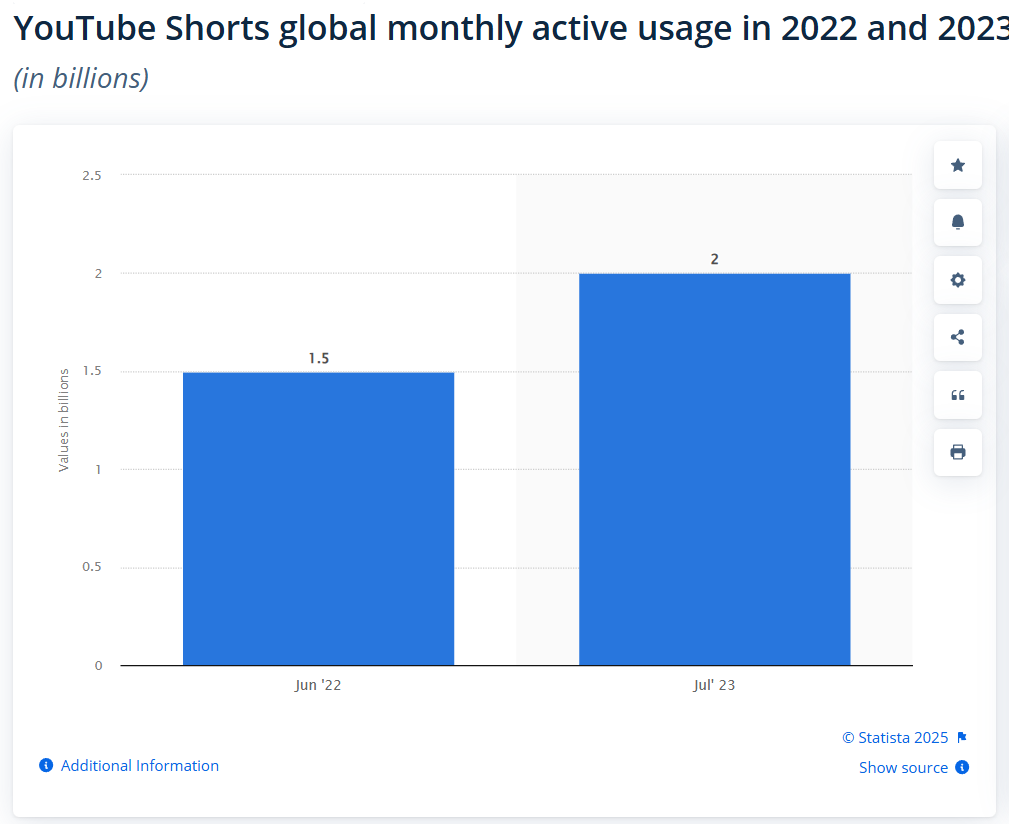
This opens up a huge field for maneuver with creatives. While in Search campaigns moderation often bans for text content, in Demand Gen, visuals rule. DG allows showing the emotions of winning in YouTube Shorts, and the audience loves it. Shorts are currently consuming the lion's share of traffic, and competition there is lower than in the Facebook feed or Instagram Stories. Recent data for 2025 suggest that nearly 1/3 of all internet users watch short videos on YouTube every month. Moreover, ~21.5% of these users are people aged 25-34. Right after them is the 35-44 segment. These are the age groups that affiliates target in their campaigns.

In addition, you can target users of specific applications. No one forbids taking a list of competitors' popular casino apps, feeding it to the system, and your ads will immediately fly to those who have these apps installed or who have at least shown interest in them. This is effectively a hot audience that is impossible to target precisely in UAC. Another cool feature of Demand Gen is the ability to target campaigns by YouTube channels. For example, you can select channels of casino streamers and add them to the campaign settings. Consequently, someone who likes watching big wins live is more likely to click on the ad, install the app, and deposit themselves.
But even in this format, affiliates often encounter the typical problem of new and farmed accounts. When an affiliate attempts to utilize complex tools, such as customer lists for Lookalike Targeting, on a new account, a cautious Google becomes concerned. For Google, this is suspicious activity: why would a new advertiser have a database, and one containing users of apps that have been banned? The risk of the account being sent for document verification, business verification, or a ban increases instantly. With YeezyPay agency accounts, this issue disappears because the advertising cabinets have cumulative trust. The system sees that the account belongs to a verified MCC and grants access to advanced targeting features from the start without unnecessary suspicion. The affiliate simply loads the audience and runs traffic while competitors warm up their self-regs for weeks.

The psychology of Shorts, Reels, and TikTok lovers perfectly matches gambling. A person wants quick dopamine. They scroll through the feed to be entertained. And then they see a video with bright emotions—the slot is spinning, coins are falling. The transition from watching entertainment content to installing a game happens natively. With this approach, the user doesn't feel like something is being forced on them, as with search advertising. It works on the level of an impulse: "saw it—wanted it—clicked—installed".
Creatives for Demand Gen should be different. Boring static banners with "100% Bonus" text rarely yield good results here. You need video and dynamics. The first 3 seconds decide everything. If you don't grab attention in this short period, a swipe up follows, and a potential player is lost. Experienced webmasters in such campaigns predominantly use the UGC format, where a seemingly real person shows how they "made some money". The audience reacts better to such creatives, and algorithms pass them more easily because they look like native blogger content.

Google loves to learn in Demand Gen campaigns. For the first 2-3 days, the campaign might be unstable. It might give no impressions and then suddenly spend double the daily limit. If you work with regular accounts with a $50 spend limit, you simply won't let the campaign gain momentum. It will hit the ceiling precisely when the algorithm finds the right audience. The learning process will be interrupted, and everything will have to start over. Here, the agency model saves the day again. YeezyPay accounts do not have strict daily spend limits for newcomers. You can set a decent test budget, survive the learning phase, and start scaling the campaign when the first deposits come in. When there are no "infant" limits, the Demand Gen algorithm will work as originally intended by Google engineers, rather than as the limited trust of self-registered accounts allows.
But even without strict limits, you shouldn't write off the strategy factor. In Demand Gen, it's important to constantly track traffic quality, not just the install price. Cheap installs might not convert into registrations and deposits. Therefore, you must set up event transmission to Google Analytics 4 or GTM. The system should see precisely registrations and deposits, not just app launches. For the algorithm to link a click and a conversion inside the app, you must at least enable enhanced attribution in the account settings.

The technical part of running traffic through Demand Gen requires cleanliness. The cloaking must be perfect, and the white pages and apps must meet all Google standards. Any minor detail can cause an ad to be rejected. Often, the reason for rejection is not obvious. It might say "Malicious software" or "Bypassing the system," but in fact, the problem might hide in one extra word in the creative or an overly aggressive call to action.
Fighting Google support on your own with self-registered accounts is quite a "pleasure". Usually, support responds with a canned reply after 1–3 days. When you're scaling volume, a campaign that stands idle for three days is a serious loss of profit, if not an outright loss. The campaign burns out, and competitors take over the auction. This is where switching from the usual format to campaigns via specialized services can help. YeezyPay support not only provides a trusted "foundation" but also helps decipher the real reasons for rejections. Managers see the situation more deeply and can suggest exactly what to fix in the campaign or on the landing page to pass moderation. Quickly solving rejection issues allows you to keep campaigns active and not lose precious traffic.
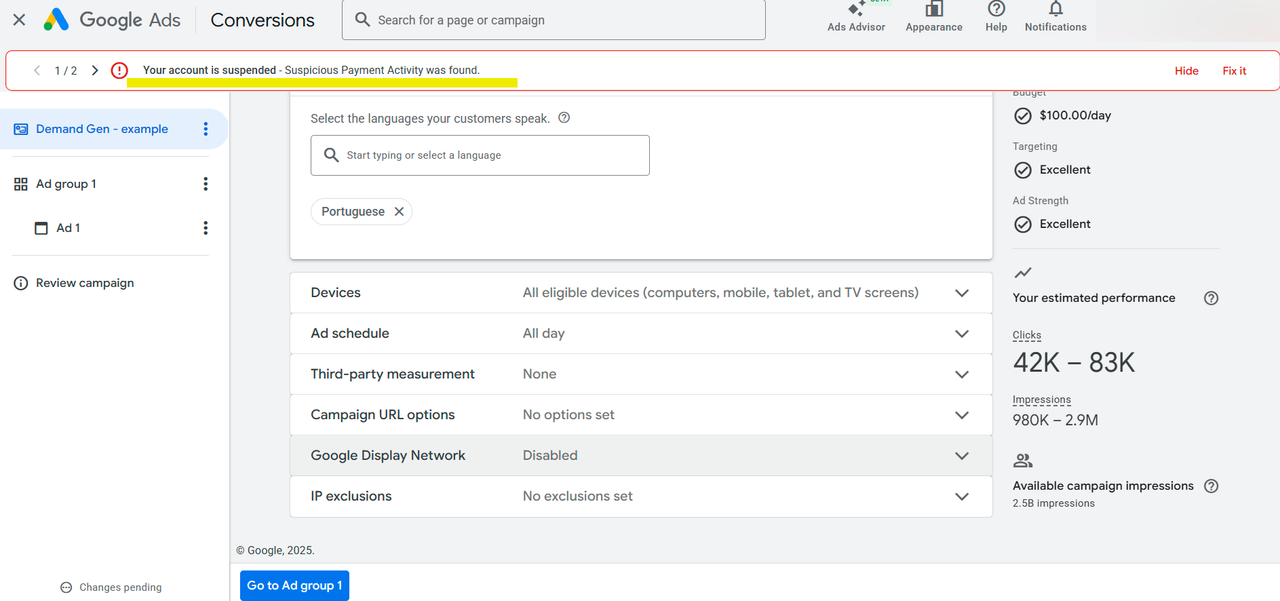
Scaling in Demand Gen also has its nuances. If an affiliate finds a campaign setup that gives ROI 100%+, there's a huge temptation to add an extra zero in the budget settings. But Google is a paranoid system. A sharp jump in spending often triggers the algorithm to check the payment profile—in other words, "Risk Payment" or "Suspicious Payment". Therefore, under ideal conditions, cards should be physical and have high trust by default. Virtual cards of questionable origin often get banned in batches.
With the switch to an agency model, this risk is minimized. Financial logistics fall on the shoulders of the service. The affiliate tops up the general balance in a convenient way, often with crypto, and a trusted legal entity with a verified payment history pays Google. Thus, provided tests are successful, you can run volumes more aggressively than with a regular account. We understand that gambling loves volume, which means if an app converts today, it might be banned tomorrow due to abnormal audience activity. You need to squeeze out the maximum here and now, and Demand Gen helps perfectly with that.
This format has everything an affiliate needs in 2025:
Google introduced this "dark horse" as a potential replacement for Discovery, but its functionality is much broader. The most appealing part is how this format truly finds the most relevant audience by using more unique behavioral patterns and data collected across various Google services. If UAC is a "black box" where you just throw in money and pray, then Demand Gen provides control and… new loopholes in moderation that affiliates love so much. In this material, we propose to find out why this tool can rightfully be considered the main alternative to UAC and how to push gambling through it with minimal loss of nerves and accounts.
Why Demand Gen is a "Legal Cheat" for Gray Hat Traffic
The main drawback of Search and standard Display campaigns is that they work based on a query. Simply put, a user types "online casino," and if you're lucky, the algorithm shows them an ad. However, the match between such a query and a keyword in the campaign settings triggers the algorithm, anti-fraud bots, and live moderators. In short, if there's a direct keyword, it means the verification must be strict. In Demand Gen, the logic is fundamentally different because it works primarily on creating demand. A person doesn't yet know they want to spin slots, but the algorithm has already calculated their interest.
The point is that in this format, there is no hard link to keywords. Google analyzes user behavior on YouTube, in Gmail, Discover recommendations, and other services. The system tracks what the user likes in Shorts, which channels they are subscribed to, and even where they leave comments and what their content is. For affiliates working with the gambling vertical, this means that moderation here is softer. There is no trigger keyword that immediately calls for a verification bot. The algorithm sees only a behavioral pattern. That is, the ad is shown not to someone looking for a "casino," but to those who are as similar as possible to a player. This nuance changes a lot when running traffic to gambling apps, as moderation has far fewer formal reasons to reject or freeze an ad for "gambling" before it gains reach.
This opens up a huge field for maneuver with creatives. While in Search campaigns moderation often bans for text content, in Demand Gen, visuals rule. DG allows showing the emotions of winning in YouTube Shorts, and the audience loves it. Shorts are currently consuming the lion's share of traffic, and competition there is lower than in the Facebook feed or Instagram Stories. Recent data for 2025 suggest that nearly 1/3 of all internet users watch short videos on YouTube every month. Moreover, ~21.5% of these users are people aged 25-34. Right after them is the 35-44 segment. These are the age groups that affiliates target in their campaigns.
How to Find Potential Players Without Keywords
Demand Gen allows you to do things that were undreamed of in UAC. There, webmasters are forced to leave everything to the algorithm. In DG, however, you can build a segment with your own hands. The "gold mine" here is Look-alike audiences. You can upload a list of people who have already made deposits in other apps, thereby speeding up the algorithm's search for similar users. As we already mentioned, unlike Meta, Google's Lookalike segments work on a massive array of data, including YouTube viewing history.
In addition, you can target users of specific applications. No one forbids taking a list of competitors' popular casino apps, feeding it to the system, and your ads will immediately fly to those who have these apps installed or who have at least shown interest in them. This is effectively a hot audience that is impossible to target precisely in UAC. Another cool feature of Demand Gen is the ability to target campaigns by YouTube channels. For example, you can select channels of casino streamers and add them to the campaign settings. Consequently, someone who likes watching big wins live is more likely to click on the ad, install the app, and deposit themselves.
But even in this format, affiliates often encounter the typical problem of new and farmed accounts. When an affiliate attempts to utilize complex tools, such as customer lists for Lookalike Targeting, on a new account, a cautious Google becomes concerned. For Google, this is suspicious activity: why would a new advertiser have a database, and one containing users of apps that have been banned? The risk of the account being sent for document verification, business verification, or a ban increases instantly. With YeezyPay agency accounts, this issue disappears because the advertising cabinets have cumulative trust. The system sees that the account belongs to a verified MCC and grants access to advanced targeting features from the start without unnecessary suspicion. The affiliate simply loads the audience and runs traffic while competitors warm up their self-regs for weeks.
YouTube Shorts as the Main Traffic Source
We've already mentioned Shorts, but it's worth dwelling on them in more detail. UAC runs ads everywhere it finds a spot. Often, these are low-quality sites where bots or competitors click through the budget. In Demand Gen, you can focus specifically on video format, and vertical videos are currently the most consumed content.The psychology of Shorts, Reels, and TikTok lovers perfectly matches gambling. A person wants quick dopamine. They scroll through the feed to be entertained. And then they see a video with bright emotions—the slot is spinning, coins are falling. The transition from watching entertainment content to installing a game happens natively. With this approach, the user doesn't feel like something is being forced on them, as with search advertising. It works on the level of an impulse: "saw it—wanted it—clicked—installed".
Creatives for Demand Gen should be different. Boring static banners with "100% Bonus" text rarely yield good results here. You need video and dynamics. The first 3 seconds decide everything. If you don't grab attention in this short period, a swipe up follows, and a potential player is lost. Experienced webmasters in such campaigns predominantly use the UGC format, where a seemingly real person shows how they "made some money". The audience reacts better to such creatives, and algorithms pass them more easily because they look like native blogger content.
Managing Bids and Budget During Scaling
Unlike Discovery, Demand Gen has introduced more bidding strategies. For starting with gambling, "Maximize Clicks" with a price limit works best to gather pixel data, or you can switch directly to tCPA if you have a powerful account. The main mistake of beginners here is giving too small a budget or, conversely, jacking it up too sharply.
Google loves to learn in Demand Gen campaigns. For the first 2-3 days, the campaign might be unstable. It might give no impressions and then suddenly spend double the daily limit. If you work with regular accounts with a $50 spend limit, you simply won't let the campaign gain momentum. It will hit the ceiling precisely when the algorithm finds the right audience. The learning process will be interrupted, and everything will have to start over. Here, the agency model saves the day again. YeezyPay accounts do not have strict daily spend limits for newcomers. You can set a decent test budget, survive the learning phase, and start scaling the campaign when the first deposits come in. When there are no "infant" limits, the Demand Gen algorithm will work as originally intended by Google engineers, rather than as the limited trust of self-registered accounts allows.
But even without strict limits, you shouldn't write off the strategy factor. In Demand Gen, it's important to constantly track traffic quality, not just the install price. Cheap installs might not convert into registrations and deposits. Therefore, you must set up event transmission to Google Analytics 4 or GTM. The system should see precisely registrations and deposits, not just app launches. For the algorithm to link a click and a conversion inside the app, you must at least enable enhanced attribution in the account settings.
Agency Approach to Demand Gen Campaigns
The technical part of running traffic through Demand Gen requires cleanliness. The cloaking must be perfect, and the white pages and apps must meet all Google standards. Any minor detail can cause an ad to be rejected. Often, the reason for rejection is not obvious. It might say "Malicious software" or "Bypassing the system," but in fact, the problem might hide in one extra word in the creative or an overly aggressive call to action.
Fighting Google support on your own with self-registered accounts is quite a "pleasure". Usually, support responds with a canned reply after 1–3 days. When you're scaling volume, a campaign that stands idle for three days is a serious loss of profit, if not an outright loss. The campaign burns out, and competitors take over the auction. This is where switching from the usual format to campaigns via specialized services can help. YeezyPay support not only provides a trusted "foundation" but also helps decipher the real reasons for rejections. Managers see the situation more deeply and can suggest exactly what to fix in the campaign or on the landing page to pass moderation. Quickly solving rejection issues allows you to keep campaigns active and not lose precious traffic.
Scaling in Demand Gen also has its nuances. If an affiliate finds a campaign setup that gives ROI 100%+, there's a huge temptation to add an extra zero in the budget settings. But Google is a paranoid system. A sharp jump in spending often triggers the algorithm to check the payment profile—in other words, "Risk Payment" or "Suspicious Payment". Therefore, under ideal conditions, cards should be physical and have high trust by default. Virtual cards of questionable origin often get banned in batches.
With the switch to an agency model, this risk is minimized. Financial logistics fall on the shoulders of the service. The affiliate tops up the general balance in a convenient way, often with crypto, and a trusted legal entity with a verified payment history pays Google. Thus, provided tests are successful, you can run volumes more aggressively than with a regular account. We understand that gambling loves volume, which means if an app converts today, it might be banned tomorrow due to abnormal audience activity. You need to squeeze out the maximum here and now, and Demand Gen helps perfectly with that.
Why You Should Test Demand Gen Right Now
Demand Gen is a breath of fresh air for those tired of the high costs of UAC. Currently, major players are only just looking at the format, and moderation hasn't tightened the screws to the max. Therefore, you can try to "skim the cream" among the first. As practice with Google shows, such a window of opportunity won't be open forever.This format has everything an affiliate needs in 2025:
- Traffic volumes;
- Smart algorithms that find people by interests, not queries;
- Ability to use video creatives;
- Less regulation compared to Search and UAC.