






Since summer of 2025, anyone running traffic through Google Ads has been weathering a prolonged storm. Algorithms have been suspending accounts in batches, and agency accounts are no exception. What felt like solid ground a year ago can now vanish within days — even with clean, white-hat warm-ups. Endless verification requests, out-of-nowhere bans for "circumventing systems," and unpredictable algorithm behavior have become routine. One thing worth clarifying upfront though: the agency accounts sold by Indian vendors on the open market and genuinely high-trust agency ad accounts are two completely different products.
YeezyPay — which gives affiliates access to high-trust Google Ads agency accounts — breaks down how Google's stance on agency accounts is actually shifting, and what to expect next. Is Google genuinely tightening control, or is this just another ban wave that'll blow over?
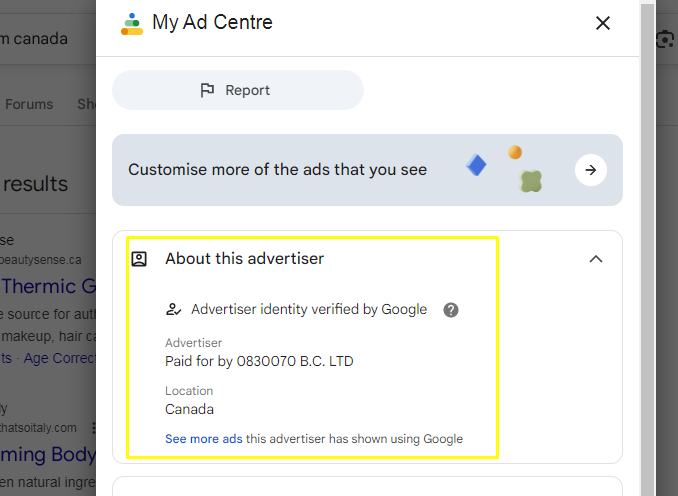
The defining shift in Google's approach in 2026 has been its all-out push for transparency — not just in the ads themselves, but in the advertisers behind them. Google now wants full visibility into the chain from business owner to final payer. Agency accounts used to sit in a kind of grey zone, and it would be dishonest to pretend they've been left untouched by this. They haven't — though Google's algorithms still treat them more leniently than standard accounts.
Where passing a basic advertiser verification used to be enough, Google is now digging deeper.
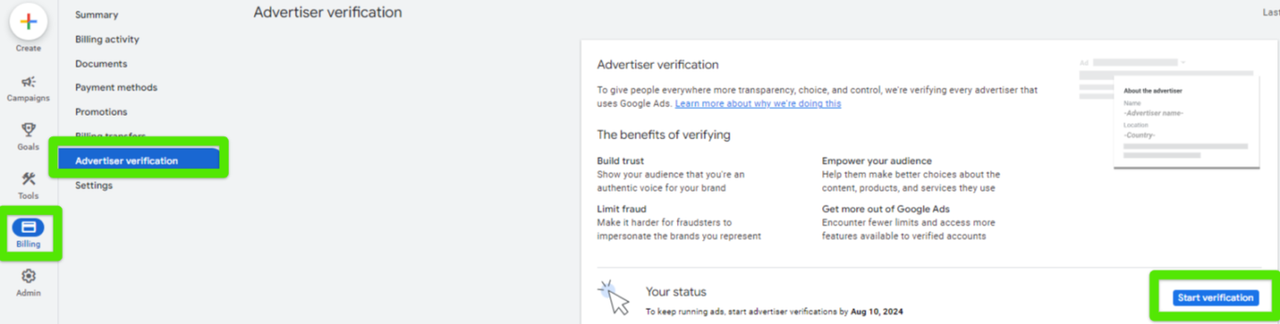
In practice, many affiliates have noticed the platform requesting business operation confirmations far more often than before. Simply put, Google is no longer content to run ads just because someone is paying — even if nothing is obviously being violated. That framing isn't entirely fair, since Google is a for-profit business at the end of the day, but the platform now wants to understand not just who the advertiser is, but what the business actually does and where the ad budget is coming from. For solo media buyers and teams alike, this creates a genuine headache. Not everyone is ready to put their real data and operational setup on the table.
This documentation process can drag on for weeks, kills momentum, and puts profitable funnels on hold. It's no surprise that many see agency accounts as the way out — specifically ones where a service provider takes on all the pain around suspensions, billing, and appeals. With agency accounts, a media buyer gets a ready-to-use ad account that has already cleared all agency-level checks, and that trust score carries over to all linked Gmail accounts. The affiliate doesn't need to prove to Google that they're not pushing something prohibited — YeezyPay allows working with grey-hat verticals through agency accounts.
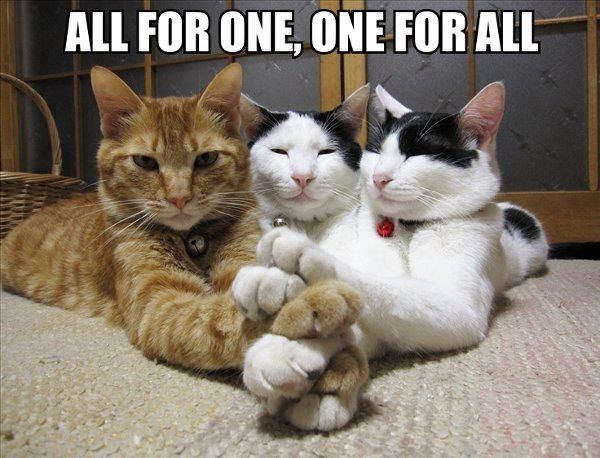
The most significant — and most dangerous — policy change involves third-party account rules. In plain terms, Google now explicitly states that if even one problematic "client" exists within an MCC account, sanctions can land on everyone connected to it. This is the chain suspension the whole industry dreads. The system spots a violation on one account, flags the entire manager account as high-risk, and sweeps everyone attached to it pending investigation.
Running alongside other affiliates in the same MCC used to be a non-issue. Now, in its drive to control everything, Google has turned even this into a lottery. Picture two media buyers running under the same agency ad account — one is running gambling traffic with years of cloaking experience, the other launches something aggressively grey-hat without knowing what they're doing and catches a ban. The first one can go down with them. It's easier for the algorithm to nuke the entire agency account than to untangle who was responsible for what.
Google now formally reserves the right to temporarily suspend any client account linked to an agency while a violation is being investigated. The updated third-party policies explicitly state that the client account must be unlinked from the MCC before ad delivery from the agency ad account can resume. This is exactly why affiliates are increasingly looking for setups where risks are contained. YeezyPay addresses this by providing access to trusted agency accounts across 10+ GEOs, personally controlling account quality and keeping toxic neighbors out. Affiliates using their ad accounts don't have to worry about someone else's mistakes torpedoing their campaigns. And if an agency account does get suspended, any remaining ad budget can be withdrawn or moved to another account.
When enough negative signals accumulate, the system deliberately drives up click costs and triggers manual reviews with increasing frequency. This is why starting with real agency accounts that already carry an established trust score has become essential — not just convenient. Scaling is significantly easier when a YeezyPay ad account is perceived by Google from day one as belonging to a serious, legitimate advertiser. Even if rapid budget increases eventually draw attention, they don't do so immediately.
YeezyPay — which gives affiliates access to high-trust Google Ads agency accounts — breaks down how Google's stance on agency accounts is actually shifting, and what to expect next. Is Google genuinely tightening control, or is this just another ban wave that'll blow over?
Google Now Wants to Know Where Your Ad Budget Comes From
The defining shift in Google's approach in 2026 has been its all-out push for transparency — not just in the ads themselves, but in the advertisers behind them. Google now wants full visibility into the chain from business owner to final payer. Agency accounts used to sit in a kind of grey zone, and it would be dishonest to pretend they've been left untouched by this. They haven't — though Google's algorithms still treat them more leniently than standard accounts.
Where passing a basic advertiser verification used to be enough, Google is now digging deeper.
In practice, many affiliates have noticed the platform requesting business operation confirmations far more often than before. Simply put, Google is no longer content to run ads just because someone is paying — even if nothing is obviously being violated. That framing isn't entirely fair, since Google is a for-profit business at the end of the day, but the platform now wants to understand not just who the advertiser is, but what the business actually does and where the ad budget is coming from. For solo media buyers and teams alike, this creates a genuine headache. Not everyone is ready to put their real data and operational setup on the table.
This documentation process can drag on for weeks, kills momentum, and puts profitable funnels on hold. It's no surprise that many see agency accounts as the way out — specifically ones where a service provider takes on all the pain around suspensions, billing, and appeals. With agency accounts, a media buyer gets a ready-to-use ad account that has already cleared all agency-level checks, and that trust score carries over to all linked Gmail accounts. The affiliate doesn't need to prove to Google that they're not pushing something prohibited — YeezyPay allows working with grey-hat verticals through agency accounts.
One Banned Sub-Account Can Suspend Your Entire MCC
The most significant — and most dangerous — policy change involves third-party account rules. In plain terms, Google now explicitly states that if even one problematic "client" exists within an MCC account, sanctions can land on everyone connected to it. This is the chain suspension the whole industry dreads. The system spots a violation on one account, flags the entire manager account as high-risk, and sweeps everyone attached to it pending investigation.
Running alongside other affiliates in the same MCC used to be a non-issue. Now, in its drive to control everything, Google has turned even this into a lottery. Picture two media buyers running under the same agency ad account — one is running gambling traffic with years of cloaking experience, the other launches something aggressively grey-hat without knowing what they're doing and catches a ban. The first one can go down with them. It's easier for the algorithm to nuke the entire agency account than to untangle who was responsible for what.
Google now formally reserves the right to temporarily suspend any client account linked to an agency while a violation is being investigated. The updated third-party policies explicitly state that the client account must be unlinked from the MCC before ad delivery from the agency ad account can resume. This is exactly why affiliates are increasingly looking for setups where risks are contained. YeezyPay addresses this by providing access to trusted agency accounts across 10+ GEOs, personally controlling account quality and keeping toxic neighbors out. Affiliates using their ad accounts don't have to worry about someone else's mistakes torpedoing their campaigns. And if an agency account does get suspended, any remaining ad budget can be withdrawn or moved to another account.
Google's AI Is Striking First
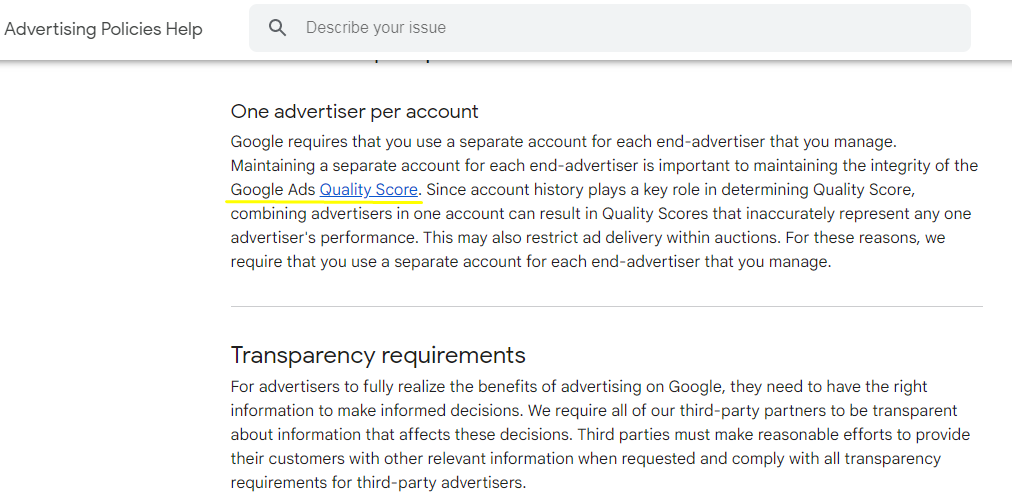
Google's AI has gotten smarter — and more suspicious. It now analyzes not just the final state of a campaign, but all activity within the ad account over time. Google's documentation calls this "Quality Score," but in practice it operates more like a shadow audit, quietly building the account's trust score in the background.
When enough negative signals accumulate, the system deliberately drives up click costs and triggers manual reviews with increasing frequency. This is why starting with real agency accounts that already carry an established trust score has become essential — not just convenient. Scaling is significantly easier when a YeezyPay ad account is perceived by Google from day one as belonging to a serious, legitimate advertiser. Even if rapid budget increases eventually draw attention, they don't do so immediately.
