







MirandaWright's
Active Member
Another old topic but I totally think USA faked the moon landing.. why?
well top reasons:
Blueprints
NO BLUEPRINTS
THE SOVIET UNION HAD BETTER TECHNOLOGY AND HAD ADVANCED MORE IN SPACE INVESTIGATION
ask yuri


the mechanical issues usa faced
and the mysterious consecutive murders of some alleged participants of the conspiracy.

Cropped photo of Buzz Aldrin saluting the flag (note the fingers of Aldrin's right hand can be seen behind his helmet).
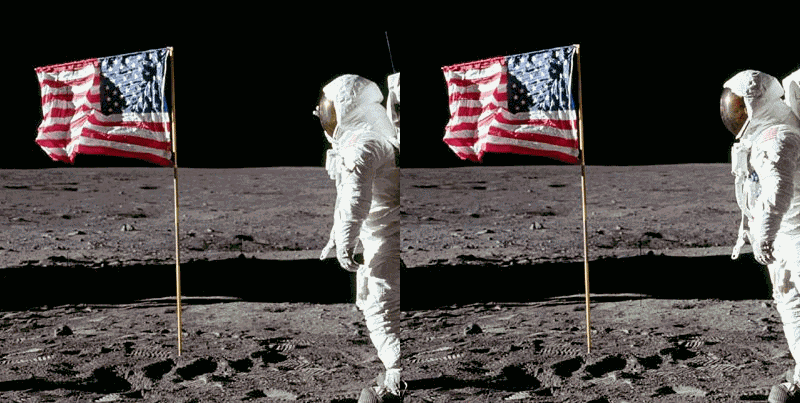
Animation of the two photos, showing that though Armstrong's camera moved between exposures, the flag is not waving.

fail they should learn to use the healing tool
Credit Ruben UGNW.net
well top reasons:
Blueprints
NO BLUEPRINTS
Technologyhe website Xenophilia.com documents a hoax claim that blueprints for the Apollo Lunar Module, Lunar rover, and associated equipment are missing.
THE SOVIET UNION HAD BETTER TECHNOLOGY AND HAD ADVANCED MORE IN SPACE INVESTIGATION
ask yuri
Photographs and filmshe became the first human in outer space and the first to orbit the Earth. He received medals from around the world for his pioneering tour in space.
and many other reasons that I'm to lazy to list like the lack of delay in the transition from the moon to earth .,.1. Crosshairs appear to be behind objects.
Overexposure causes white objects to bleed into the black areas on the film.
2. Crosshairs are sometimes misplaced or rotated.
Popular versions of photos are sometimes cropped or rotated for aesthetic impact.
3. The quality of the photographs is implausibly high.
There are many poor quality photographs taken by the Apollo astronauts. NASA chose to publish only the best examples.[83][84]
The Apollo astronauts used high resolution 70mm professional cameras and film.[85]
4. There are no stars in any of the photos. The Apollo 11 astronauts also claimed in a press conference after the event to have not remembered seeing any of the stars.
The sun was shining. Cameras were set for daylight exposure, and could not detect the faint points of light.[86] Even the brightest stars are dim and difficult to see in the daytime on the Moon. Neil Armstrong said that he could not see stars on the daylight side of the Moon with his naked eyes.[87] Edwin Aldrin saw no stars from the Moon [88] Harrison Schmitt saw no stars from the Moon.[89] The astronauts' eyes were adapted to the brightly sunlit landscape around them so that they could not see the relatively faint stars. Camera settings can turn a well-lit background into ink-black when the foreground object is brightly lit, forcing the camera to increase shutter speed in order not to have the foreground light completely wash out the image. A demonstration of this effect is here. The effect is similar to not being able to see stars outside when in a brightly-lit room - the stars only become visible when the light is turned off. The astronauts could see stars with the naked eye only when they were in the shadow of the Moon. All of the landings were in daylight.[90]
5. The color and angle of shadows and light are inconsistent.
Shadows on the Moon are complicated by uneven ground, wide angle lens distortion, light reflected from the Earth, and lunar dust.[91] Shadows also display the properties of vanishing point perspective leading them to converge to a point on the horizon.
This theory was demonstrated to be unsubstantiated on the MythBusters episode "NASA Moon Landing".
6. Identical backgrounds in photos which, according to their captions, were taken miles apart.
Shots were not identical, just similar. Background objects were mountains many miles away. Without an atmosphere to obscure distant objects, it can be difficult to tell the relative distance and scale of lunar features.[92] One specific case is debunked in Who Mourns For Apollo? by Mike Bara.[93]
7. The number of photographs taken is implausibly high. Up to one photo per 50 seconds.[94]
Simplified gear with fixed settings permitted two photographs a second. Many were taken immediately after each other. This calculation was based on a single astronaut on the surface, and does not take into account that there were two persons sharing the workload during the EVA.
8. The photos contain artifacts like the two seemingly matching 'C's on a rock and on the ground.
The "C"-shaped image was from printing imperfections, not in the original film from the camera.[95][96]
9. A resident of Perth, Australia, with the pseudonym "Una Ronald", said she saw a soft drink bottle in the frame.
No such newspaper reports or recordings have been verified. "Una Ronald"'s existence is authenticated by only one source. There are also flaws in the story, i.e. the emphatic statement that she had to "stay up late" is easily discounted by numerous witnesses in Australia who observed the event to occur in the middle of their daytime, since this event was an unusual compulsory viewing for school children in Australia.[97]
10. The book Moon Shot contains an obvious composite photograph of Alan Shepard hitting a golf ball on the Moon with another astronaut.
It was used in lieu of the only existing real images, from the TV monitor, which the editors of the book apparently felt were too grainy to present in a book's picture section. The book publishers did not work for NASA.
11. There appear to be "hot spots" in some photographs that look like a huge spotlight was used at a close distance.
Pits in Moon dust focus and reflect light in a manner similar to minuscule glass spheres used in the coating of street signs, or dew-drops on wet grass. This creates a glow around the photographer's own shadow when it appears in a photograph. (see Heiligenschein)
If the photographer is standing in sunlight while photographing into shade, light reflected off his white spacesuit produces a similar effect to a spotlight.[98]
12. Footprints in the extraordinarily fine lunar dust, with no moisture or atmosphere or strong gravity, are unexpectedly well preserved, in the minds of some observers – as if made in wet sand.
The dust is silicate, and this has a special property in a vacuum of sticking together like that. The astronauts described it as being like "talcum powder or wet sand".[93]
This theory was demonstrated to be unsubstantiated on the MythBusters episode "NASA Moon Landing".
the mechanical issues usa faced
and the mysterious consecutive murders of some alleged participants of the conspiracy.
Cropped photo of Buzz Aldrin saluting the flag (note the fingers of Aldrin's right hand can be seen behind his helmet).
Animation of the two photos, showing that though Armstrong's camera moved between exposures, the flag is not waving.
fail they should learn to use the healing tool
Credit Ruben UGNW.net


