






Imagine a situation: an affiliate logs into the Google Ads dashboard to launch a gambling campaign. He goes to the Optimization Score section and sees several cards: "enable AI Max: +34% conversions!", "Enable Search Partners: +30% impressions!" The offer seems tempting. He agrees. A week passes, and it turns out that all this time he was running at a loss, and now he doesn’t know what to do.
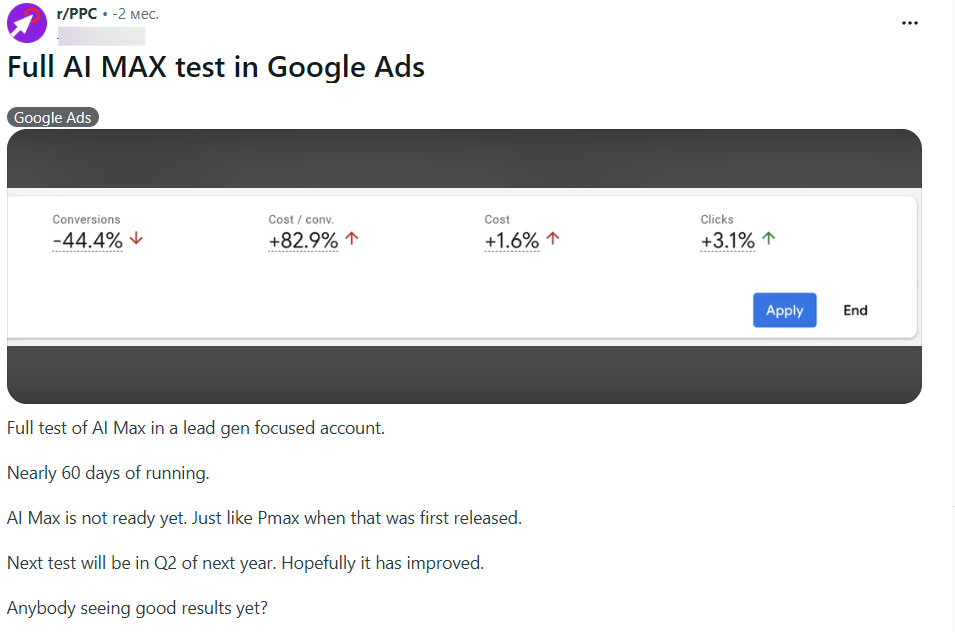
For many affiliates, this nightmare became a reality in May 2025, when the AI Max feature entered open beta. For example, one media buyer shared the results of two months of AI Max testing on Reddit. The conversion rate during this time dropped by 44%.
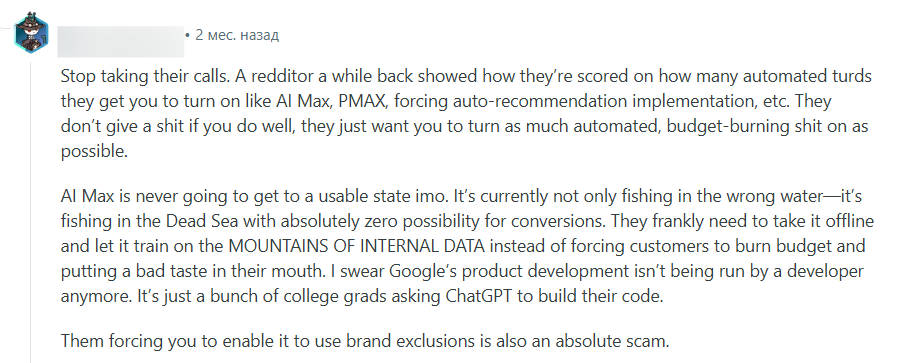
Users in discussions do not hesitate to speak out harshly. The feature is called an outright scam; someone writes that Google support is paid not for help, but for forcing them to enable AI functions. Such complaints are systematic because the problem is very common: people write that the feature is unfinished and for now, "catches fish not just in the wrong water, but in the Dead Sea."
And if an affiliate works with gray-hat verticals like gambling, they may be surprised to find that on the 18th-20th day, their account will be banned. This happens because AI Max is highly likely to start promoting the offer for keywords like "online casino" or "online slots big wins," to which Google sometimes reacts aggressively.
To bypass these problems, affiliates usually either give up AI Max or use agency accounts: MCC allow them to manage the AI and impose negative keyword restrictions across all advertising campaigns without a lengthy warm-up period. Decisions made in the agency account get priority in the eyes of the platform. Let's look at examples of how AI from Google drains budgets in the gambling niche and find out how to deal with this problem.
How ad campaign automation actually works in Google Ads
Previously, Google automated campaigns with only two algorithms: Smart Bidding and Performance Max. The first algorithm set the most profitable CPC automatically, and the second determined on which platforms the audience would be able to see the creatives. Now Google's AI mechanisms work more complexly and combine three different functions that come in one package: Close Variants, AI Max, and Search Partners.
Each mechanism expands reach, which means it increases the number of impressions, clicks, and, consequently, costs. As intended, expanded reach is used so that the platform can learn more effectively and bring better ROI percentages. In practice, a significant part of the budget is spent on irrelevant traffic. Let's look at each of the AI mechanisms and find out how they kill ROI and what can be done about it.
Close Variants: inaccurate "exact" match
The first AI function in Google's assortment is the Close Variants mechanism. In theory, this is a great feature: artificial intelligence picks up words from the exact match category and finds keywords closest to them in meaning. The "close in meaning" category includes the following queries:
Such practices lead to unprofitable clicks. If you are running ads for payday loans, for example, then the offer will be displayed not only for "online microloans", but also for "take a microloan without interest", and for "how to quickly repay a microloan", and even for the query "file for bankruptcy". The statements are confirmed by proofs: the media Search Engine Journal checked over 4.5 million clicks on "close variants" and found that more than 40% of them are irrelevant.
Statistics are also confirmed by live cases. Complaints regularly appear on Reddit that "close variants" promote an offer for completely unsuitable queries.
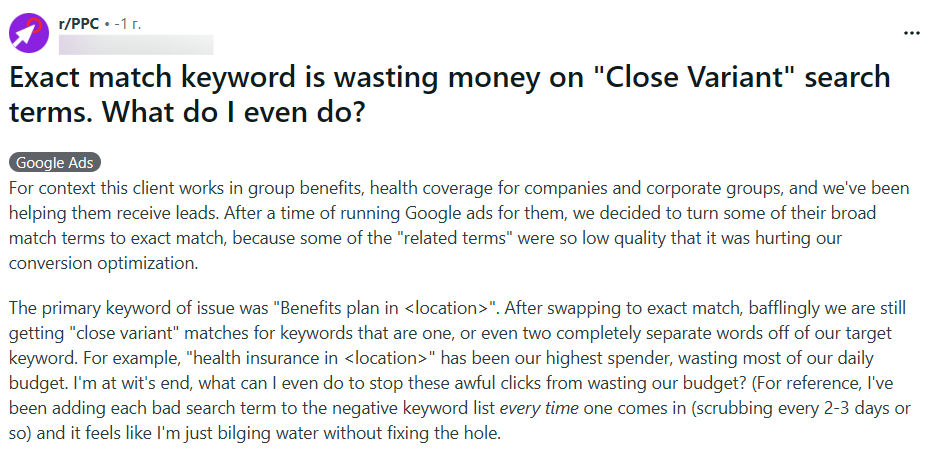
Below is an example of such a case. The situation is crazy: a person sells health insurance to corporations, and Google, because of "close variants", shows his offer to those who want to order private insurance.
The problem is that if an affiliate uses AI Max, they cannot turn off this function. He has to constantly track unsuccessful "close variants" and add them to negative keywords. It becomes especially difficult if a media buyer runs several campaigns from different accounts — it may be physically impossible to have time to enter all possible negative keywords, and the budget will end up being wasted.
Agency accounts solve this problem: they allow you to create a shared list of negative words that are applied to all advertising campaigns at once. Moreover, there can be several of these lists — from universal ones that prohibit specific words for all offers, to specific ones for a specific product. As a result, you can save a significant budget and significantly increase ROI.
AI Max – automation that has to be configured manually
The second AI feature of Google, and concurrently the main one among them, is AI Max. AI Max is an automated bidding strategy based on machine learning. Google says the following about it: "AI Max uses the Smart Bidding function and analyzes millions of signals in real time — from the user's device to the time of day. Based on them, the system determines the optimal bid for each auction."
In theory, it sounds great: you invested the advertising budget, turned on AI Max, and forgot about manual configuration; the system itself converts advertising into money. Cases, however, show the opposite result. Complaints about AI Max fill Reddit, Google Support, and BlackHatWorld.
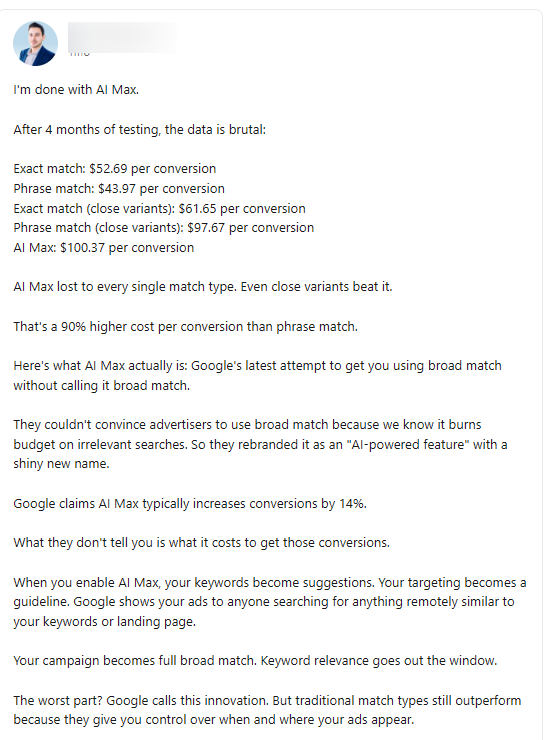
A detailed review of the algorithm was left on LinkedIn by one marketer. He tested AI Max for 4 months and found that this mechanism brings at least twice as expensive leads as Phrase Match and Exact Match. Given that the algorithm settings cannot be changed during tests, otherwise AI Max starts learning all over again — the results are discouraging.
The main problem with AI Max is its learning period. Within 1-2 weeks, the algorithm aims for the widest reach in order to select the optimal strategy for advertising. For the statistics to be correct, AI Max requests a budget at least 15 times higher than the target price per conversion. That is, if an affiliate wants his lead to cost $30, he must spend $450 per day. The logic of this system is this: the more often AI Max receives data, the faster it will learn. In practice, this is almost always a waste of thousands of dollars, because after several months of testing, the model does not learn to work more effectively, and you get worse results than with manual traffic driving. According to research, 99% of clicks from AI Max do not lead to conversions, but you must pay for them.
The main problem is the complete ignorance of manual edits. AI Max learning simply resets to the starting point if you try to fix its data yourself.
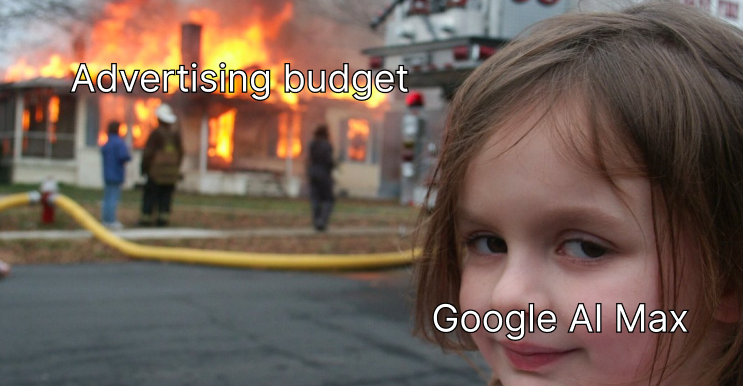
Learning can last for 4-6 weeks, burning inordinately large budgets and not bringing any results at all. This problem hits affiliates especially hard, who can fit an entire campaign into these terms because funnels burn out quickly. Those who use agency accounts have fewer difficulties with AI Max. The agency dashboard allows you to install the Monthly Budget Pacing script, which will not allow AI Max to exceed the desired advertising budget even when the algorithm is actively learning. This does not solve the problem completely, but it allows at least to save the budget and achieve higher ROI percentages.
Search Partners, or traffic that you didn't order
The third AI mechanic in the Google Ads arsenal is Search Partners. This function allows ads to be shown not only in Google, but also on partner sites: Yahoo, Bing and so on. Together with traffic from Google Ads, you get traffic from partners at the same cost per click. AI Max uses this mechanism especially actively: on partner sites, according to Google, lies the most valuable data for their algorithms.
On paper, again, it sounds great: the reach is wide, AI Max is actively learning. In fact, the mechanism works not just "badly", but catastrophically: a study of 220,000 clicks for 2025 showed that 30% of traffic from Search Partners is fraud.
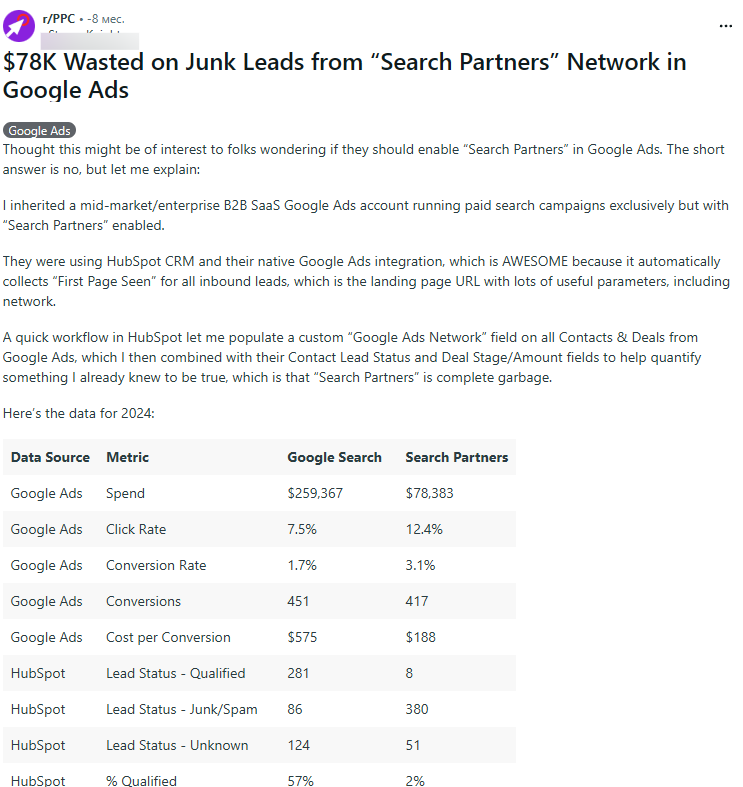
Similar studies are repeatedly confirmed by the experience of affiliates. A revealing case about the work of Search Partners was left by one media buyer on Reddit: he invested $80,000 in promotion through "Google partners" and received only $17,000, resulting in a heavy loss. For comparison, advertising in Google Search brought $727,000. Such large losses can only be explained in one way: small search platforms pour fraudulent clicks for which affiliates must pay money.
Affiliates who work with gray-hat niches should disable Search Partners immediately. Because of the Close Variants mechanics, there is a high probability that the offer will be shown on one of the platforms for a prohibited query, and the account will immediately go into ban. If a media buyer prefers white-hat verticals, a script should be created or installed that will itself turn off Search Partners if it does not pay off. Putting it on every account is difficult and long. Google Ads agency accounts, meanwhile, allow you to spread the script to dozens of accounts in a couple of clicks and solve this problem at the root.
Summary
Marketers and affiliates hope that in the near future the company will finalize the artificial intelligence algorithms, but so far, the situation is discouraging. Each of the AI mechanisms has similar problems. Both Close Variants, AI Max, and Search Partners waste budgets, bring fraudulent traffic, and increase the risk of blocking.
Too wide a reach, prohibited keys in Close Variants, and inability to configure algorithms manually can ruin even successful advertising campaigns at the root. Google Ads agency accounts from YeezyPay help save the budget due to the MCC capability to control algorithms. For example, through the agency account, you can set a list of negative words for all advertising campaigns or enter scripts that keep the budget under control. This will not knock down the AI Max learning. And due to high trust, algorithms react to rule violations less often, so even Close Variants will not ruin a campaign if you react quickly to prohibited keywords.
For many affiliates, this nightmare became a reality in May 2025, when the AI Max feature entered open beta. For example, one media buyer shared the results of two months of AI Max testing on Reddit. The conversion rate during this time dropped by 44%.
Users in discussions do not hesitate to speak out harshly. The feature is called an outright scam; someone writes that Google support is paid not for help, but for forcing them to enable AI functions. Such complaints are systematic because the problem is very common: people write that the feature is unfinished and for now, "catches fish not just in the wrong water, but in the Dead Sea."
And if an affiliate works with gray-hat verticals like gambling, they may be surprised to find that on the 18th-20th day, their account will be banned. This happens because AI Max is highly likely to start promoting the offer for keywords like "online casino" or "online slots big wins," to which Google sometimes reacts aggressively.
To bypass these problems, affiliates usually either give up AI Max or use agency accounts: MCC allow them to manage the AI and impose negative keyword restrictions across all advertising campaigns without a lengthy warm-up period. Decisions made in the agency account get priority in the eyes of the platform. Let's look at examples of how AI from Google drains budgets in the gambling niche and find out how to deal with this problem.
How ad campaign automation actually works in Google Ads
Previously, Google automated campaigns with only two algorithms: Smart Bidding and Performance Max. The first algorithm set the most profitable CPC automatically, and the second determined on which platforms the audience would be able to see the creatives. Now Google's AI mechanisms work more complexly and combine three different functions that come in one package: Close Variants, AI Max, and Search Partners.
Each mechanism expands reach, which means it increases the number of impressions, clicks, and, consequently, costs. As intended, expanded reach is used so that the platform can learn more effectively and bring better ROI percentages. In practice, a significant part of the budget is spent on irrelevant traffic. Let's look at each of the AI mechanisms and find out how they kill ROI and what can be done about it.
Close Variants: inaccurate "exact" match
The first AI function in Google's assortment is the Close Variants mechanism. In theory, this is a great feature: artificial intelligence picks up words from the exact match category and finds keywords closest to them in meaning. The "close in meaning" category includes the following queries:
- Words with spelling errors or typos
- Declensions by number
- Words with the same root — for example, "delivery" and "deliver"
- Abbreviations and acronyms
- Words with the same meaning, but in different formulations
- Implied words
Such practices lead to unprofitable clicks. If you are running ads for payday loans, for example, then the offer will be displayed not only for "online microloans", but also for "take a microloan without interest", and for "how to quickly repay a microloan", and even for the query "file for bankruptcy". The statements are confirmed by proofs: the media Search Engine Journal checked over 4.5 million clicks on "close variants" and found that more than 40% of them are irrelevant.
Statistics are also confirmed by live cases. Complaints regularly appear on Reddit that "close variants" promote an offer for completely unsuitable queries.
Below is an example of such a case. The situation is crazy: a person sells health insurance to corporations, and Google, because of "close variants", shows his offer to those who want to order private insurance.
The problem is that if an affiliate uses AI Max, they cannot turn off this function. He has to constantly track unsuccessful "close variants" and add them to negative keywords. It becomes especially difficult if a media buyer runs several campaigns from different accounts — it may be physically impossible to have time to enter all possible negative keywords, and the budget will end up being wasted.
Agency accounts solve this problem: they allow you to create a shared list of negative words that are applied to all advertising campaigns at once. Moreover, there can be several of these lists — from universal ones that prohibit specific words for all offers, to specific ones for a specific product. As a result, you can save a significant budget and significantly increase ROI.
AI Max – automation that has to be configured manually
The second AI feature of Google, and concurrently the main one among them, is AI Max. AI Max is an automated bidding strategy based on machine learning. Google says the following about it: "AI Max uses the Smart Bidding function and analyzes millions of signals in real time — from the user's device to the time of day. Based on them, the system determines the optimal bid for each auction."
In theory, it sounds great: you invested the advertising budget, turned on AI Max, and forgot about manual configuration; the system itself converts advertising into money. Cases, however, show the opposite result. Complaints about AI Max fill Reddit, Google Support, and BlackHatWorld.
A detailed review of the algorithm was left on LinkedIn by one marketer. He tested AI Max for 4 months and found that this mechanism brings at least twice as expensive leads as Phrase Match and Exact Match. Given that the algorithm settings cannot be changed during tests, otherwise AI Max starts learning all over again — the results are discouraging.
The main problem with AI Max is its learning period. Within 1-2 weeks, the algorithm aims for the widest reach in order to select the optimal strategy for advertising. For the statistics to be correct, AI Max requests a budget at least 15 times higher than the target price per conversion. That is, if an affiliate wants his lead to cost $30, he must spend $450 per day. The logic of this system is this: the more often AI Max receives data, the faster it will learn. In practice, this is almost always a waste of thousands of dollars, because after several months of testing, the model does not learn to work more effectively, and you get worse results than with manual traffic driving. According to research, 99% of clicks from AI Max do not lead to conversions, but you must pay for them.
The main problem is the complete ignorance of manual edits. AI Max learning simply resets to the starting point if you try to fix its data yourself.
Learning can last for 4-6 weeks, burning inordinately large budgets and not bringing any results at all. This problem hits affiliates especially hard, who can fit an entire campaign into these terms because funnels burn out quickly. Those who use agency accounts have fewer difficulties with AI Max. The agency dashboard allows you to install the Monthly Budget Pacing script, which will not allow AI Max to exceed the desired advertising budget even when the algorithm is actively learning. This does not solve the problem completely, but it allows at least to save the budget and achieve higher ROI percentages.
Search Partners, or traffic that you didn't order
The third AI mechanic in the Google Ads arsenal is Search Partners. This function allows ads to be shown not only in Google, but also on partner sites: Yahoo, Bing and so on. Together with traffic from Google Ads, you get traffic from partners at the same cost per click. AI Max uses this mechanism especially actively: on partner sites, according to Google, lies the most valuable data for their algorithms.
On paper, again, it sounds great: the reach is wide, AI Max is actively learning. In fact, the mechanism works not just "badly", but catastrophically: a study of 220,000 clicks for 2025 showed that 30% of traffic from Search Partners is fraud.
Similar studies are repeatedly confirmed by the experience of affiliates. A revealing case about the work of Search Partners was left by one media buyer on Reddit: he invested $80,000 in promotion through "Google partners" and received only $17,000, resulting in a heavy loss. For comparison, advertising in Google Search brought $727,000. Such large losses can only be explained in one way: small search platforms pour fraudulent clicks for which affiliates must pay money.
Affiliates who work with gray-hat niches should disable Search Partners immediately. Because of the Close Variants mechanics, there is a high probability that the offer will be shown on one of the platforms for a prohibited query, and the account will immediately go into ban. If a media buyer prefers white-hat verticals, a script should be created or installed that will itself turn off Search Partners if it does not pay off. Putting it on every account is difficult and long. Google Ads agency accounts, meanwhile, allow you to spread the script to dozens of accounts in a couple of clicks and solve this problem at the root.
Summary
Marketers and affiliates hope that in the near future the company will finalize the artificial intelligence algorithms, but so far, the situation is discouraging. Each of the AI mechanisms has similar problems. Both Close Variants, AI Max, and Search Partners waste budgets, bring fraudulent traffic, and increase the risk of blocking.
Too wide a reach, prohibited keys in Close Variants, and inability to configure algorithms manually can ruin even successful advertising campaigns at the root. Google Ads agency accounts from YeezyPay help save the budget due to the MCC capability to control algorithms. For example, through the agency account, you can set a list of negative words for all advertising campaigns or enter scripts that keep the budget under control. This will not knock down the AI Max learning. And due to high trust, algorithms react to rule violations less often, so even Close Variants will not ruin a campaign if you react quickly to prohibited keywords.